
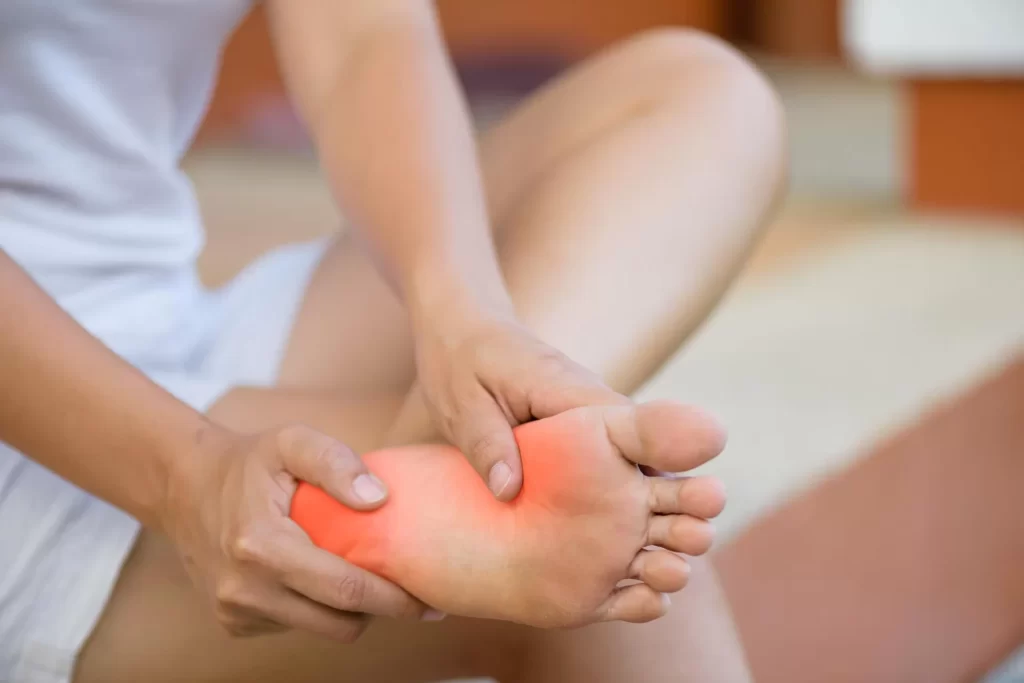
Metatarsalgia Treatment in New Canaan, CT
Metatarsalgia refers to pain and inflammation in the ball of the foot — specifically in the area of the metatarsal heads, the rounded ends of the five metatarsal bones that form the front portion of the foot. This condition is extremely common and can range from a mild ache to a sharp, burning pain that makes every step feel like walking on pebbles.
At New Canaan Podiatry in New Canaan, CT , Dr. Jennifer Tauber, DPM, provides expert evaluation and effective treatment for metatarsalgia. Call (203) 548-7688 or book online today.
Book OnlineWhat Causes Metatarsalgia?
Metatarsalgia develops when the metatarsal heads bear excessive or abnormally concentrated pressure. Common causes include:
- High-impact activities such as running and jumping that concentrate repetitive force under the ball of the foot
- Wearing high-heeled shoes that shift body weight forward onto the metatarsal heads
- A foot structure with unusually long metatarsals, high arches, or hammertoes that alter forefoot pressure distribution
- Flat feet that reduce the arch’s shock-absorbing function and increase forefoot loading
- Being overweight, which increases pressure on the entire foot
- Thinning or atrophy of the fat pad beneath the ball of the foot, which often occurs with aging
- Morton’s neuroma — a thickening of the tissue around the digital nerve between the third and fourth toes that can mimic or accompany metatarsalgia
Symptoms of Metatarsalgia
- Sharp, aching, or burning pain in the ball of the foot
- Pain that worsens with standing, walking, running, or walking barefoot on hard surfaces
- Pain that improves with rest
- A sensation of walking with a pebble or stone in your shoe
- Numbness or tingling in the toes in cases involving nerve compression
Treatment Options at New Canaan Podiatry
- Rest and activity modification to reduce metatarsal loading
- Metatarsal pads and cushioning to redistribute forefoot pressure
- Custom orthotics with metatarsal support to reduce concentrated pressure under the symptomatic metatarsal heads
- Appropriate footwear with a wide toe box, low heel, and adequate forefoot cushioning
- Anti-inflammatory medications for pain management
- Corticosteroid injections for targeted relief in refractory cases
- MLS Laser Therapy to reduce inflammation non-invasively
- Liposana treatment to restore fat pad volume beneath the metatarsal heads
Frequently Asked Questions
Is metatarsalgia the same as Morton’s neuroma?
They are different conditions that can occur simultaneously. Metatarsalgia is a broad term describing ball-of-foot pain caused by excessive pressure. Morton’s neuroma is specifically a thickening of the tissue around a digital nerve, typically between the third and fourth toes, causing sharp, burning, or electric-shock-like pain. Dr. Tauber will differentiate between these conditions during your evaluation.
Can custom orthotics help metatarsalgia?
Yes. Custom orthotics with a precisely positioned metatarsal pad are one of the most effective long-term treatments for metatarsalgia, redistributing pressure away from the painful metatarsal heads and reducing cumulative stress during walking and running.
Can Liposana injections help metatarsalgia caused by fat pad atrophy?
Yes. Liposana treatment uses human adipose tissue to restore volume to the fat pad beneath the ball of the foot. For patients whose metatarsalgia is caused by atrophy of this natural cushioning, Liposana can provide significant relief by restoring the protective padding that has diminished with age or activity.
Does metatarsalgia require surgery?
In the vast majority of cases, metatarsalgia responds well to conservative treatment. Surgery is rarely needed and is typically reserved only for cases where a specific structural problem — such as an overly long metatarsal or a prominent metatarsal head — cannot be adequately managed conservatively.
What shoes are best for metatarsalgia?
Shoes with a wide, rounded toe box, a low heel (under 1 inch), adequate forefoot cushioning, and a rocker-bottom sole (which reduces peak pressure under the ball of the foot during toe-off) are most beneficial. High-heeled, narrow, or flat, rigid shoes should be avoided.
Can metatarsalgia go away on its own?
Mild metatarsalgia sometimes improves with rest and footwear changes alone. However, if an underlying biomechanical issue is driving the condition, it will typically recur or persist without addressing the root cause through custom orthotics or other targeted interventions.
How is metatarsalgia diagnosed?
Diagnosis is based on clinical examination, symptom history, and in-office digital X-rays to evaluate the metatarsal bones and rule out stress fractures or other bony abnormalities. Diagnostic ultrasound may be used to assess soft tissue structures and evaluate for Morton’s neuroma.